


What History Is Good For: Patterns, Perspective and Discipline

Samuel Ziff
Partner | Portfolio ManagerSam Ziff joined OP in April 2013. He was previously employed by J.P. Morgan Cazenove working in the UK Industrials Corporate Finance team for a total of 4 years. He graduated from Oxford University. He is CIO, manages the global equity portfolios, and contributes to the overall investment selection.



At Oldfield Partners we spend a great deal of time reading financial and business history. It is the best guide we have to the future, and it gives us four things: patterns, perspective, discipline, and a check on our own temperament. History teaches that disruption is always a real risk, but it also shows us how businesses have navigated disruption before.
Patterns History Provides
The tulip craze, the South Sea Bubble, 1929, the Nifty Fifty, Japan in the 1980s, the dot-com boom. These examples illustrate that there is often an innovation, or at least the pretence of one, and the claim that it is different this time. Why? In 1720 Isaac Newton, one of the smartest men ever to live, got caught up in the South Sea Bubble because he could not stand people, he thought less clever than him getting richer than him. Fear of missing out “FOMO” contributes to every great bubble.
Sometimes it is the business cycle to be wary of (think 2008). Sometimes it is capital cycles, that is exceptionally high returns attract capital, and capital competes those returns away. Margins then revert to the mean and moats disappear. Brilliant businesses are much rarer than the brilliant stories about businesses.
Sometimes it is valuations. The Nifty Fifty was the lesson in taking on too much valuation risk even where business risk was minimal. In this instance, some of the greatest businesses of the era (McDonald’s, Coca-Cola, P&G) traded at fifty times earnings and higher and suffered material falls in price as they derated.
A company’s own history is also important. Ryanair, a holding in the International Value Strategy, placed the largest order for narrowbody planes four months after September 11th, when the airline industry was in disarray. Showing how Michael O’Leary, the CEO, is willing to invest when competitors are retrenching. A long record often tells us more than a three-year forecast. Fairfax and JD Wetherspoon, held across OP strategies and still run by their respective founders, both put their financial performance since founding on page one of the annual report. Almost no other firm does this.
History as a Source of Discipline
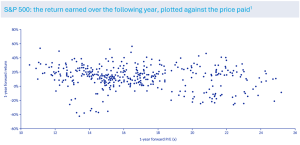
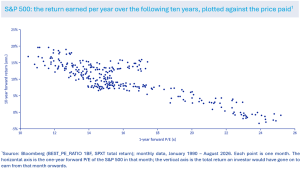
These patterns are only observable over the long run. Valuation is the clearest example. Over one year, noise drowns out the signal, and the starting valuation does not explain returns. Over ten years, as the charts for the S&P 500 below show, it explains a great deal. The first chart shows no correlation between valuation and returns. The second slopes steadily downhill, illustrating that buying at around 12x delivered mid-teens percentage returns over the following decade, while buying above 22x delivered close to zero.
Valuation is where every investment we look at starts; forget it at your peril.
Perspective
The average age of the companies in the Global Strategy is around 100 years. This is not something we explicitly target, but longevity provides a better period to observe a business. This can reveal several factors, one of which is resilience.
Merck KGaA, a German healthcare and life science business, exemplifies resilience. It is the oldest company in the Global Strategy, founded 358 years ago. The company has survived World Wars, the Great Depression and many rounds of disruption to the pharmaceutical industry. Survival is not proof of future resilience; but it gives us confidence in the company’s ability to withstand financial and geopolitical shocks going forward.
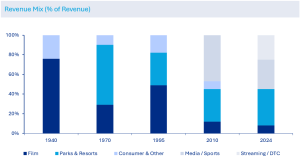
Disney is another company that has faced ups and downs. Founded by Walt Disney in 1923, the studio released Snow White, Pinocchio, Fantasia, Dumbo and Bambi in the space of five years, between 1937 and 1942. The animated content that Disney produces provides it with an edge over other film producers as it is recycled across generations. How many other films from the 1930s are re-released today? As the media industry enters the era of streaming, we are confident Disney can adapt as it has done before. The chart below shows how Disney’s revenue has shifted over time from Film to Parks to TV and back again. Today the business is well spread across a range of distribution channels and continues to produce timeless content: Moana and Frozen delight in the way that Snow White once did.
A Check on Our Own Temperament
History teaches the importance of temperament as well as analysis. Analysis guides us in what we need to do, whilst temperament guides us in how. Market sentiment is an important part of the investing process as it swings from optimism to pessimism and back again.
Graham distilled this in The Intelligent Investor with Mr Market, a business partner who turns up each morning with a price, elated on some days, despondent on others. The prices that are quoted are there to serve, not to instruct or influence. History reminds us of when to engage and when to ignore him. The hardest moments are the market tops and the market bottoms, the points at which contrarianism feels most foolish.
Where Does It Take Us?
History shapes how we work. We read widely across the history of markets and of the businesses we invest in, and we hope to achieve two things: an insight that is useful today, and a reminder that we are not the first to face what we face.
This gives us better perspective than studying just the present, which makes us slower to be excited and slower to despair. That is where we think our edge comes from.


 United Kingdom
 United States
 Canada
 Other
Other