


Quarterly Insights by Richard Oldfield – 2Q 2026

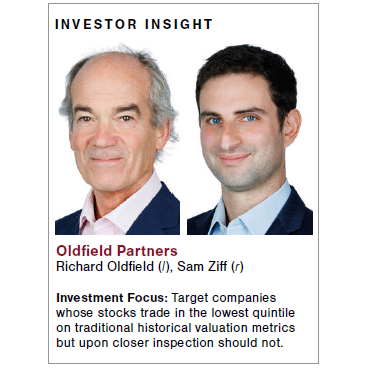
Richard Oldfield
Chair | PartnerRichard Oldfield founded Oldfield Partners LLP in 2005, after 9 years as chief executive of a family investment office. Before this, he was director of Mercury Asset Management plc, which he joined in 1977. He was Chairman of the Oxford University investment committee and the first chairman of Oxford University Endowment Management Ltd from 2007-2014.
He is now chairman of Shepherd Neame Ltd, and trustee of a number of charities. The second edition of his book “Simple But Not Easy”, a “slightly autobiographical and heavily biased” book about investing, was published by Harriman House in December 2021.

There is no such thing as a ‘value’ company. Companies have different valuations at different times, the result of the vagaries of their own fortune and of waves of enthusiasm and gloom. From time to time companies with high rates of growth wander by accident into our valuation territory. The portfolios we manage have benefited this year and last from the presence of two or three semiconductor companies which for no very good reason were trading at extremely low valuations – and still are, because earnings have shot up. We do not have entrenched views about sectors or types of companies and recent performance has been a credit to this flexibility. We are interested in companies with low valuations because so often too much pessimism is the cause of a low valuation and too much optimism the cause of a high valuation.
When share prices rise by a couple of hundred percent in a year or less, it does, however, provoke a question: could the value of these companies really have tripled over the past year? Was the world ignorant of the fact that AI data centres would need a vast number of semiconductors? Are we all, as Oscar Wilde put it, people who know the price of everything and the value of nothing?
We are in a fascinating period, the mood as upbeat for markets as it is downbeat for world politics. Markets are always fascinating to those who have investment in their blood, but there are times when they are especially so. Even the most technologically hopeless of us can understand some of the magical effects of AI in making things easier; can worry about the effect of AI on employment for graduates in professions like law, accountancy and investment – and, indeed, data science and computer coding – over the next several years; and then simply wonder about the larger effects on humanity, a puzzle to which no one yet has an answer.
But then there are markets, and markets go wild with enthusiasm.
‘A trend is a trend is a trend,’ wrote the economist Alec Cairncross.
‘But the question is, will it bend? Will it alter its course through some unforeseen force and come to a premature end?’ To this we would add: a bubble is a bubble is a bubble. When stocks double and double, the bubble is trouble. Watch out you’re not left with just rubble.
The recent listing of SpaceX has all the hallmarks of the beginning of the end in a particular area of markets. A stratospheric valuation, stratospheric growth expectations, even a stratospheric business with a genius behind it all; authorities bending over backwards to accommodate by changing their listing rules and even their insider trading rules; people who have never invested before pouring in.
Some things are infinite: numbers, because to the biggest number a child is asked to think of, one can always be added; suitcases, because it is always possible to squeeze in an extra pair of socks. It always seems possible to blow once more into a balloon. There comes a time in markets when most of the participants are saying ‘I think we can get just a little bit more breath into this balloon’ and a vociferous minority is saying, ‘this is not a balloon at all. It is a beautiful psychedelic supersonic ever-expanding spherical miracle.’ But actually, a balloon is a balloon, and balloons pop.
We quote Peter Cundill frequently: ‘There is always something to do’. We continue to feel this strongly in spite of all the reasons for alarm. There are lots of exciting opportunities even at a time when many corners of markets are overvalued and, it seems to us, risky: ‘Value’ is back. Despite an initial ‘safe haven’ blip, the notions of the US dollar’s ‘exorbitant privilege’ and of US exceptionalism have been undermined rather than underlined by the Iran war. Our portfolios have an average price-earnings multiple of around eleven, and we believe there is plenty of upside.



 United Kingdom
 United States
 Canada
 Other
Other