

Last Orders? The Capital Cycle in American Whiskey

Anindita Nag
AnalystAnindita joined OP in 2023 as an analyst contributing to the overall investment selection. Prior to OP, she worked as an investment analyst within the 4Factor Emerging Markets equity team at Ninety One. Anindita holds a MA (Cantab.) in Economics from the University of Cambridge and an MSc in Finance and Economics from the London School of Economics and Political Science (LSE), and is a CFA Charterholder.


The market is fixated on falling whiskey demand. The real story may be barrels of trouble sitting in Kentucky warehouses.

The Morning After
There is something fitting about writing a piece on whiskey stocks at a moment when the industry appears to have had one too many. After decades of roaring growth — fuelled by premiumisation, the cocktail culture boom, and a pandemic-era surge in at-home drinking — the American whiskey industry is nursing a hangover. Sales have slowed sharply, stocks have fallen steeply from their peaks, and the industry is confronting a reckoning that has rattled even the most storied whiskey names.
For long-term value investors, however, such moments of maximum pessimism are often the ones worth paying closest attention to.
Spirits in the Doldrums
To understand where we are, it helps to consider where we have been. For much of the past two decades, the global spirits industry was one of the most reliable compounding stories in consumer goods. Cocktail culture was spreading. Consumers were trading up. And as spirits steadily took share from beer across developed markets, higher-end bourbons and Tennessee whiskeys evolved into “aspirational” products, winning shelf space and pricing power around the world.
Then came Covid. With consumers stuck at home and “premiumising” their drinking, distillers read the pandemic surge as a permanent shift, not a one-off. Distillery expansions accelerated; private equity poured into new craft whiskey capacity; and producers across the industry committed to multi-year investments in anticipation of continued growth.
However, the pandemic-era exuberance did not just fade — it reversed.
In late 2023, demand cooled sharply, not just for whiskey, but across beverage alcohol more broadly. The United States — the industry’s most important profit pool — recorded its first annual decline in total beverage alcohol volumes in 30 years. Far from rebounding, though, the weakness persisted: volumes first fell 3% in both 2023 and 2024, then worsened to 5% in 2025.
By now, investors have grown increasingly sceptical and many leading spirits franchises that once traded on 20–30x earnings have seen their multiples compress to below 15x. What initially looked like a cyclical post-pandemic correction is gradually evolving into a much broader question about the future of alcohol consumption itself.
But what is causing this malaise? The honest answer is that nobody knows for certain.
Much of the sector’s de-rating appears to reflect an unusually noisy debate about why people are drinking less.
One camp argues this is mostly a passing squall: real incomes are stretched, hospitality spend is under pressure, and post-pandemic destocking has amplified the downturn. The argument follows: as the consumer recovers, so will the bottle.
The other camp, however, suspects something more lasting is at work. Looming over the industry are the now familiar “Big Three” concerns: Gen Z consumers who drink markedly less than their parents did at the same age, rapid uptake of GLP-1 weight-loss drugs that appear to dampen appetite for alcohol, and growing cannabis and THC substitution in the United States. The structural issue could ultimately be that the industry is confronting a cultural reorientation in wellness: a glass of wine or a dram is no longer the default end to the day.
For whiskey stocks, however, this debate, important though it is, may be the wrong place to focus. While demand matters across the industry, treating spirits as a single category risks overlooking the very different economics that underpin each one.
In whiskey, the story does not end with demand.
Time as Moat and Trap
Making whiskey is not like making vodka or gin. A bottle of vodka or gin can be made today and sold within weeks. A bottle of bourbon sold in 2026 was, by law, distilled and laid down years earlier — for a minimum of two to four years, but often six or eight, and sometimes far longer for more premium expressions. That long maturation process is part of what gives whiskey its allure: age creates scarcity, scarcity supports premium pricing, and brands can build remarkable cachet over decades. But that same ageing process also means producers are constantly making capital allocation decisions based on an uncertain view of demand several years, if not a decade, out.
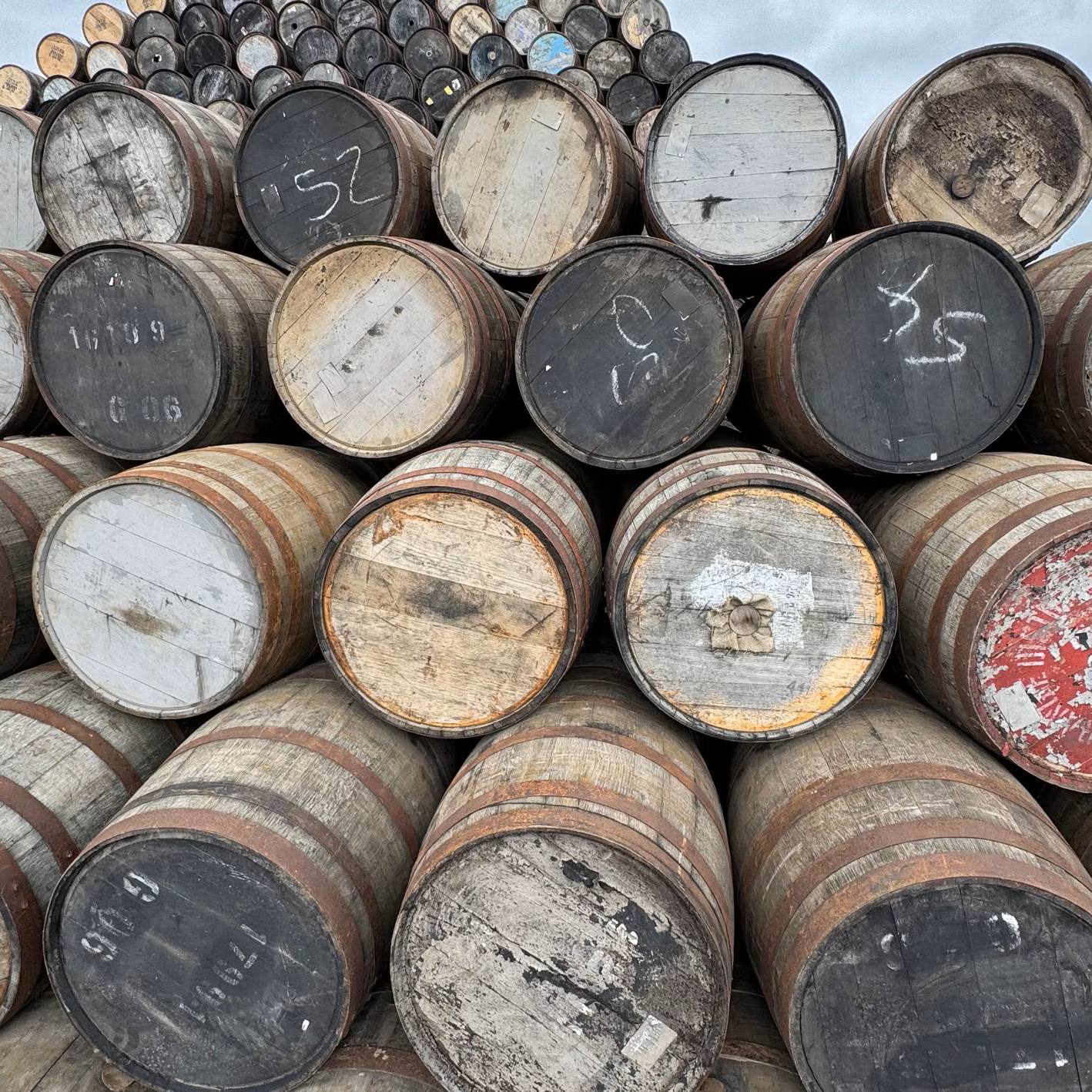
When Covid came along in 2020, after a multi-decade upcycle, the industry doubled down on future demand with enormous conviction. Distilleries expanded, warehouses multiplied, and barrels were filled at record rates. The result is now impossible to ignore. By mid-2025, barrelled American whiskey inventories had reached an all-time high of nearly 1.5 billion proof gallons[1] — roughly triple 2012 levels, and up more than 70% since just 2019.
Unlike soft drinks, vodka or gin producers, however, whiskey producers cannot simply slow production and normalise inventories within months. The barrels filled during the boom years cannot be uncorked early; they will continue ageing regardless of whether demand ultimately materialises. At the same time, domestic sales and exports together absorbed barely 100 million proof gallons in the United States last year. The arithmetic is uncomfortable.
Echoes of the Whisky Loch
History offers a compelling and cautionary parallel here because the Scotch industry has seen this film before. In the 1970s, riding a post-war export boom in blended whisky, Scotch distillers expanded aggressively on the assumption that demand would continue to compound. Stills were added, warehouses filled, and optimism became deeply embedded across the industry. Then the global recession of the early 1980s arrived, blends fell out of fashion, and the industry was left, in the memorable Scottish phrase, sitting on a “Whisky Loch” — a vast lake of maturing spirit with nowhere to go. Distilleries closed by the dozen — including names now mourned by connoisseurs such as Brora and Port Ellen. It took the better part of two decades for the surplus to clear.
The lesson is not that history will repeat exactly. It is that, in whisky, the adjustment period can be far longer than equity investors are conditioned to expect. Demand plainly matters — and short-term demand indicators inevitably dominate market attention. But the supply side moves with such a lag — and with such inertia — that, ultimately, it is the inventories quietly ageing in warehouses that can end up dominating the cycle.
Hiding in Plain Sight
Capital-cycle investors may start recognising this rhythm. Industries with long lead times and heavy upfront investment — mining, shipping, semiconductors — tend to oscillate between boom and bust in predictable waves. When demand is buoyant and returns are high, producers and their financiers invest aggressively, extrapolating today’s conditions far into the future. Supply accumulates slowly, in lumps, and arrives years later, often overshooting long after demand has already moved on.
Whiskey does not look like one of these industries at first glance. It looks like a premium consumer staple: strong brands, loyal drinkers and pricing power. But underneath, the ageing process creates many of the same dynamics — long supply lags, irreversible investment, and inventories that cannot simply be unwound once committed. In many ways, whiskey is a classic capital-cycle industry hiding in plain sight.
Like all such industries, though, the whiskey capital cycle will also turn. When excess inventory weighs on pricing and profitability, capital discipline begins to re-emerge — stronger players cut production and weaker producers fail. Quietly, the seeds for the next upswing are sown.
And the good news for the patient investor, if not for the mid-cycle producer, is that this reckoning in American whiskey has now well and truly begun.
Sobering Up
After years of filling barrels with the confidence of a boom that would never end, Suntory Global Spirits — the Japanese conglomerate behind some of America’s biggest bourbon brands — announced late last year it would pause distillation at its flagship Jim Beam plant in Kentucky throughout 2026. The decision marked one of the starkest pullbacks the American whiskey industry had seen in a generation. Nor is Suntory alone: British spirits giant Diageo has also reined in production across several well-loved brands, including Bulleit and George Dickel.
Lower down the industry, weaker players are beginning to fail outright. Garrard County Distilling Co. once billed as the symbol of Kentucky’s craft boom ambition, shut its doors carrying roughly $26 million of debt last year. Smaller bourbon producers 52 Eighty and Luca Mariano have filed for bankruptcy.
Perhaps the loudest signal, though, is the corporate activity at the top of the industry. Within the space of a few weeks this spring, both Sazerac — America’s largest privately held spirits company — and Pernod Ricard — the French giant behind Absolut and Jameson — emerged as suitors for Brown-Forman, the 155-year-old family-controlled owner of Jack Daniel’s. Whatever the outcome, two bidders appearing at once for one of America’s greatest drinks dynasties is telling.
In capital-cycle industries, periods of stress are often when industry leaders begin laying the foundations for the next upturn. Sazerac and Pernod’s bids may be the clearest signal yet that the smart money has already begun to think beyond the hangover, while much of the market is still trying to diagnose it.
Brands or Barrels?
So, what does any of this mean for how we, as long-term value investors, approach the sector?
Much of our thinking on spirits — and indeed the piece you are reading — began with a long look at Brown-Forman. The business is a genuine high-quality franchise: Jack Daniel’s remains the world’s best-selling American whiskey, Woodford Reserve has built real cachet among premium drinkers, and the Brown family has carefully compounded the business across five generations. The stock is now down over 60% from its 2022 high and trades at roughly 16x forward earnings, versus a ten-year average closer to 30x. On valuation alone, the shares have rarely looked more compelling.
But the deeper we went, the more we found ourselves asking a different question: in whiskey, are we underwriting the brands or the barrels?
Because in whiskey, unlike almost any other consumer industry, a company’s most important asset is not the name on the label. It is millions of physical barrels sitting in warehouses across Kentucky, laid down years ago in more optimistic times.
Even with curtailed production now, inventories across the industry have barely declined. Stress is also starting to emerge in the wholesale market, where bulk barrel prices have dropped sharply. This is an unglamorous but telltale sign that surplus spirit is now looking for a home at almost any price.
Where does that leave us? In the near term, the bear case is probably right. Even if demand picks up in earnest, the sheer volume of spirit already maturing in Kentucky’s warehouses may weigh on pricing and discounting for years to come.
But capital cycles do correct themselves eventually. Every barrel not filled today is supply that will not exist five or six years from now. Even if demand recovers only modestly by then, the industry could tighten surprisingly quickly. The bulls may simply be right on a different timescale.
So, the real question is not whether American whiskey will eventually recover. It is which businesses are best positioned to survive the path between now and then.
Choosing the Bottle
At this point in the cycle, we find ourselves less drawn to the purest expressions of American whiskey than to the businesses best positioned to age gracefully through the adjustment.
That begins with diversification. A pure-play American whiskey producer like Brown-Forman is, in effect, a concentrated bet on one liquid, one supply cycle and one set of trade arrangements. We are presently more comfortable with the Diageos of the world — globally diversified spirits owners where American whiskey sits alongside Scotch, Irish whiskey, tequila and gin. Diversification, in this industry, is another word for time: it buys the holding period that a single-category business cannot afford.
Next, we are looking for balance sheet resilience. A company that must service heavy debt while its inventory ages for another five years has very little room for error. A company with low leverage, cash flow from a broad portfolio, and the ability to pause distillation for a year — as Suntory has just done at Clermont — has the luxury of letting the cycle work in its favour rather than against it.
Finally, access to global growth matters. The United States dominates today’s debate, but it is unlikely to dominate the industry’s next decade of growth. Much of the long-term opportunity lies in emerging markets, where spirits consumption still has considerable room to run. India has quietly become the world’s largest export market for Scotch by volume; imported spirits have grown at roughly 16% a year since 2019. The businesses best positioned for the next cycle may not be those with the fullest warehouses, but those with the broadest routes to market.
Patience, In a Glass
The American whiskey capital cycle has begun to turn, but it has not yet finished turning. Inventories remain high, pricing pressure is real, and the adjustment process may still take years to play out. Markets are right to be cautious.
But great spirits brands are rare assets. Jack Daniel’s, Johnnie Walker and Woodford Reserve have survived two world wars, multiple recessions, Prohibition and the original Whisky Loch. This hangover, too, shall pass.
The investors who ultimately do well from this period are unlikely to be those trying to precisely time the bottom. More likely, they will be those willing to use the downturn to identify durable, well-financed and globally diversified spirits businesses — and then give the cycle time to heal.
In investing, as in distilling, patience is usually rewarded.
[1] The industry’s standard unit for measuring spirit volume: one gallon at 50% alcohol. Mostly useful for making warehouse inventories sound as enormous as they are.



 United Kingdom
 United States
 Canada
 Other
Other